Author
Bowtie Team
Updated on
2025-06-13
Disclaimer: This article is translated with the assistance of AI.
For insurance newbies, the first big dilemma when buying life insurance is whether to go for whole life insurance or term life insurance.
Whole life insurance, also known as Whole Life, combines “life protection” and “savings” elements, while term life insurance, or Term Life, only provides “life protection” coverage. The product structures are quite different.
If you’re unsure whether whole life or term life is right for you, check out these three handy guides first:
Hong Kong folks are savvy shoppers – they compare prices for everything from milk tea to bread, so it’s no surprise they do the same for life insurance.
When comparing different life insurance products, you might notice that term life insurance premiums are often much cheaper than whole life insurance. But does that mean term life offers less coverage or more restrictions?
The answer is no.
Let’s quickly recap the differences between whole life and term life insurance.
Whole life insurance not only provides life protection but also includes a savings component , with cash value and/or annual dividends that offer some guaranteed returns. On the flip side, term life insurance is a “pure protection” product , meaning it only pays out on death without any savings elements or policy value.
The reason term life insurance has that affordable premium edge is due to its no-frills, no-savings nature – it’s like ordering tea at a cha chaan teng without the extra HK$3 for an iced drink; the simpler the product, the lower the cost.
In terms of policy terms, term life and whole life insurance generally have similar covered and excluded items. For instance, with Bowtie Term Life , the only exclusion is the suicide clause ( if the insured dies by suicide within one year of the policy’s effective date, regardless of mental state at the time, it’s not covered ), which is standard for most whole life policies out there.
Unlike term life insurance, whole life insurance has a fixed premium payment period, which can be as short as a few years or as long as several decades, depending on the plan’s terms. Once the premium payment period ends, the policyholder doesn’t need to pay premiums anymore, and the life insurance coverage continues.
Because whole life insurance combines “savings” and “life insurance” elements, under the same premium, the coverage of whole life insurance is lower than that of term life insurance.
Therefore, many people, after finishing payments for whole life insurance, wonder whether they should buy an additional pure life insurance to increase the coverage amount, or even withdraw the cash value from whole life insurance to purchase term life insurance.
Since the guaranteed cash value, non-guaranteed annual bonuses, non-guaranteed terminal bonuses, and accumulated interest (if any) of whole life insurance continue to grow and earn interest over time, theoretically, the cash value will keep increasing. However, if you withdraw the cash value or transfer it to another policy during this period, it will affect the final returns upon maturity, essentially wasting the time invested. So, as a rule , it’s not recommended to withdraw the cash value from whole life insurance unless absolutely necessary .
Compared to whole life insurance, term life insurance premiums are more affordable, making it ideal for those who want to fill the coverage gaps left by whole life insurance but are worried about the financial strain of paying for two life insurance policies at once.
All Bowtie products are “pure protection,” with low premiums and high leverage ratios—for every HK$1,000,000 in coverage, the monthly premium can be as low as HK$24*. Under the same premium, Bowtie Term Life offers up to 40 times more coverage than typical savings-based life insurance products^, plus flexible payment periods that won’t result in financial losses if you stop payments midway. This effectively helps people at different life stages bridge their protection gaps.
Every life insurance policy has a Beneficiary , which is the designated person who can apply for compensation if the insured passes away unfortunately.
Generally speaking, insurance companies only accept immediate family members, spouses, or legal heirs as beneficiaries for life insurance policies, but in rare cases, they might also accept fixed partners or unmarried couples.
Some people choose to keep their life insurance policy and its beneficiary confidential after purchasing it, and they don’t inform anyone around them about the decision.
So, if the insured suddenly passes away and the beneficiary isn’t aware they’re the beneficiary, what happens to the life insurance death benefit?
If the insured clearly informs the beneficiary about the existence of the life insurance policy before passing away, the beneficiary can then submit a claim to the insurance company with the deceased’s identification documents, death certificate, and other required information after the insured’s death.
However, if the beneficiary doesn’t know they’re the beneficiary and doesn’t proactively submit a claim to the insurance company, the life insurance policy that hasn’t yet matured will continue in force until it expires or is terminated due to non-payment of premiums .
If you’ve purchased a term life insurance policy that requires periodic renewal and haven’t clearly informed your relatives, the policy could lapse due to overdue premium payments after your death, making it even harder for the beneficiary to claim the death benefit.
Bowtie Term Life has no claim submission deadline, so beneficiaries won’t be denied payment for submitting a claim late—as long as valid proof documents are provided, the death benefit can be claimed at any time.
Some insurance companies also have dedicated teams to handle such cases. However, since the insurance company can’t know right away that the insured has passed away, these teams typically only deal with whole life insurance policies that have been overdue for a long time without any claims, actively searching for beneficiaries using the policy’s name and contact information.
That said, after many years, the beneficiary might have passed away or relocated, so the most prudent and suitable approach is to let someone you trust know about your life insurance policy early on to avoid wasting the coverage altogether.
When the insured passes away, the insurance company will pay the death benefit to the policy beneficiary. Besides the usual one-time lump-sum payment, the policyholder can actually choose in advance to have the amount paid out in installments to the beneficiary.
After a Bowtie Term Life claim is approved, the insurance company typically pays the benefit in two ways:
As for the benefit amount, whole life term insurance includes a savings component, so returns are split into guaranteed and non-guaranteed benefits. If the insurance company’s investment strategy doesn’t perform as hoped, the beneficiary might end up receiving less than what the policyholder originally expected.
On the other hand, pure protection term life insurance like Bowtie Term Life doesn’t have a savings element, so there’s no such uncertainty. For instance, the death benefit equals 100% of the sum assured, with no deductions for fees or administrative costs, paid fully to the beneficiary.
According to Common Law , no one can profit unjustly from purchasing insurance, which is “insurance fraud.”
To address this, most medical insurance, accident insurance, travel insurance, and similar policies include an “other insurance” clause. If the policyholder has other coverage for the same risks, they must disclose it honestly to avoid claiming the full amount from multiple insurers for the same event.
So, can you buy more than one life insurance policy at the same time?
The answer is yes .
Unlike other reimbursement-based insurances, even if the policyholder has multiple life insurance policies and hasn’t declared them, as long as there’s no misconduct—such as falsifying personal information or fraud—the insurance company is still obligated to pay the full sum assured to the beneficiary upon the insured’s death.
Bowtie Term Life is a term life insurance policy where you pay monthly premiums for life coverage up to HK$8,000,000*, providing ample financial support for your partner, children, or parents.
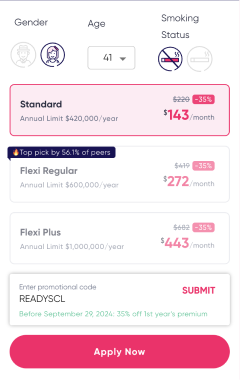
For Bowtie Term Life, each HK$1,000,000 of coverage costs as low as HK$38 per month. Get a quote now!

© 2026 Bowtie Life Insurance Company Limited. All rights reserved.