Author
Bowtie Team
Updated on
2025-12-29
Disclaimer: This article is translated with the assistance of AI.
Each insurance company’s outpatient insurance has different definitions and coverage scopes, with significant variations. Most outpatient insurance plans generally cover general practitioner visits and specialist doctor consultations , while some extend coverage to Chinese medicine , physiotherapists , chiropractors , and bone-setters . Some policies even include prescribed Western medications , X-rays and laboratory tests , occupational/speech therapy , or day surgery fees .
| Age Limits | |
| Minimum age for coverage | 15 days to 18 years |
| Maximum age for coverage | 50 to 64 years |
| Renewal age | 65 to 75 years / lifelong |
Outpatient insurance plans on the market do not require an underwriting procedure , so policyholders do not need to provide health information for themselves or the insured to successfully apply.
However, outpatient insurance has age restrictions; the youngest eligible age is 15 days, and the oldest is generally up to 64 years. Note that not all plans guarantee lifelong renewal, as renewal depends on individual circumstances.
| Main Medical Services | Deductible * |
| General practitioner | $0 – 50 |
| Specialist doctor | $0 – 100 |
| Physiotherapist | $0 – 150 |
| Chinese medicine | $0 – $50 |
| Bone-setter | $0 – $50 |
Purchasing outpatient insurance does not mean you have a “medical card” for free doctor visits.
To prevent abuse of insurance, some outpatient plans require the insured to pay a fixed deductible (commonly known as excess), meaning the insured must cover part of the cost for each outpatient visit, with amounts exceeding the deductible covered by the insurance company.
Of course, some outpatient insurance plans have no deductible, but “you get what you pay for”—these policies tend to have higher premiums. Those considering coverage should weigh the premiums against the deductible levels to choose the right plan.
Most outpatient insurance plans have a medical network restriction, meaning the policy only allows policyholders to receive treatment and services from doctors or clinics within the insurer’s medical network.
It’s worth noting that the size of the medical network can vary significantly between different outpatient insurance plans, ranging from over 200 to more than 2,000 healthcare providers.
Those considering a policy should check if their family doctor or familiar clinic is included in the medical network.
Additionally, some companies impose annual visit limits, for example, capping all items at 20 to 40 claims per year, while others set limits per item, such as no limit for general practitioner Western medicine consultations, but limiting traditional Chinese medicine or specialist Western medicine to 10 or 15 visits per year.
Policyholders should also note the medication days limit per visit for both Western and Chinese medicine, as certain outpatient policies only allow doctors or Chinese medicine practitioners to prescribe up to 5 days of medication per visit to prevent abuse.
Beyond traditional general outpatient, specialist outpatient, and Chinese medicine services, many outpatient insurance plans have recently added various types of additional coverage, such as free health check-ups, injury treatment (Chinese orthopedics), physiotherapy, dental scaling, and other dental services.
Some plans even extend coverage to outpatient surgeries and cancer treatment. Policyholders can compare the additional coverage items and premium levels based on their own needs.
| Age | Annual Premium | |
| Outpatient Insurance* | Bowtie VHIS ^ | |
| 15 days to 5 years old | $2,676 – $8,016 | $1,320 – $1,860 |
| 6 to 60 years old | $2,080 – $7,212 | $1,140 – $5,568 |
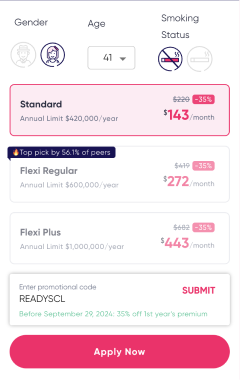
As shown in the table above, outpatient insurance premiums are not inexpensive; for a plan with $0 co-payment, you might need to pay over $7,000 annually. In comparison, for Bowtie’s VHIS Standard Plan with an annual coverage of $420,000, a 25-year-old non-smoking male would pay only $1,452 per year, which is significantly lower.
The primary function of insurance is to transfer risk to the insurer, especially for financially burdensome risks. For outpatient medical expenses that cost a few hundred dollars per visit or a few thousand per year, it may not pose a huge financial burden for those who can afford the premiums. Conversely, hospitalisation and surgery costs in the tens of thousands can create substantial financial pressure and uncertainty for many.
If your budget is limited and you want to transfer medical expense risks to an insurer, purchasing hospitalisation insurance or VHIS is more important than buying outpatient insurance.
The coverage of the Voluntary Health Insurance Scheme mainly includes inpatient and surgical expenses, but also covers some outpatient medical expenses, including “outpatient surgical fees” and “pre- and post-surgery outpatient fees” . Bowtie Flexi Plan (Regular) even adds “accident emergency outpatient coverage” . For example, for a 25-year-old male non-smoker, the annual premium is $2,760.
Therefore, if you are unfortunately diagnosed with a critical illness, having only medical insurance may cover your medical costs but not the long-term challenges that come with the illness. In fact, a critical illness often forces you to stop working and lose income, which can affect your quality of life and disrupt your existing plans.
Since medical insurance and critical illness insurance provide complementary coverage, a reliable critical illness policy can replace lost income during your absence from work, providing financial support and reducing the impact on your family, while maintaining your original quality of life.
Moreover, even if you cannot purchase new insurance after an illness, the critical illness payout can help cover your existing medical insurance premiums when necessary.
Critical illness insurance is an essential form of protection. Beyond medical insurance, the importance of critical illness insurance cannot be overlooked. In any situation, as long as you have a stable income, you should seriously consider purchasing a critical illness policy to provide additional protection.

© 2026 Bowtie Life Insurance Company Limited. All rights reserved.