Author
Bowtie Team
Updated on
2025-05-27
Disclaimer: This article is translated with the assistance of AI.
Pregnancy insurance, also known as maternity insurance, refers to insurance products that cover risks related to childbirth, prenatal and postnatal care, as well as pregnancy complications.
These pregnancy insurance products cannot be purchased independently and are offered as add-on coverage. Policyholders must also purchase hospitalisation medical insurance (typically high-end medical insurance).
As a result, insured individuals not only receive coverage for pregnancy-related matters but also for general hospitalisation and surgical medical expenses.
Common coverage under pregnancy insurance:
Common pregnancy complications typically covered by pregnancy insurance include:
Any surgery, including delivery, carries a certain level of risk. If you choose to give birth in a private hospital without insurance and an accident occurs, the medical costs can far exceed your original budget.
Here’s a real story: A young couple had always hoped to have a child. After several years of marriage, the wife finally became pregnant, and the couple was overjoyed as they prepared to welcome their little one. However, at 34 weeks, they received bad news. During a prenatal check-up, the doctor found the baby in an abnormal position with a risk of the umbilical cord wrapping around the neck.
Due to recent cases of severe complications and even deaths during childbirth in public hospitals, they decided to opt for a caesarean section in a private hospital. The couple had limited savings; after covering mortgage payments and daily expenses, they barely managed to scrape together HK$70,000 for medical costs.
They thought everything would go smoothly, but unexpectedly, after the wife gave birth via caesarean section, she experienced massive bleeding, requiring emergency surgery. In total, she underwent 5 surgeries and nearly 40 blood transfusions, resulting in a bill of almost HK$400,000. Since the wife had no insurance, they couldn’t afford the fees and had to seek media help, hoping the hospital would consider a reduction.
Most basic medical insurances classify pregnancy or related complications as excluded items (including most voluntary medical insurance policies) do not cover pregnancy and childbirth-related expenses or risks of pregnancy complications.
For example, as stated in the policy terms of one insurance company in the market: “This policy does not cover any hospitalisation, treatment, surgery, or other expenses that are directly or indirectly, wholly or partially caused by the following (including) pregnancy, miscarriage, childbirth, termination of pregnancy, or any related complications.”
Since not all medical insurances cover pregnancy or related complications, it is essential to clearly understand the coverage scope and policy details before purchasing.
Before purchasing insurance, you should check if the policy’s coverage for pregnancy complications is adequate. Additionally, if the pregnant mother unfortunately experiences complications before or after delivery, she may need observation and treatment, so the policy’s hospitalization coverage and limits should also be noted.
Pregnancy insurance policies on the market generally have a waiting period of 9 to 18 months for coverage related to delivery and pregnancy complications. Medical expenses related to pregnancy incurred during the waiting period cannot be claimed from the insurance company. Therefore, purchasing such a policy after becoming pregnant may not be the best approach.
Some pregnancy insurance policies provide specific medical coverage for the insured’s or their spouse’s newborn children, or allow the insured to add the newborn to their existing health insurance plan. Before purchasing, compare the policy terms based on your needs.
The following lists 3 insurance plans from the market that cover pregnancy complications and/or natural delivery and C-section, with premiums referenced for a 30-year-old non-smoking woman.
| Insurance Company A | Insurance Company B | Insurance Company C | |
| General Hospitalization and Surgery Compensation | |||
| Room and board fees, surgery fees, doctor fees, etc. | Full reimbursement | Full reimbursement | Full reimbursement |
| Obstetrics Coverage | |||
| Prenatal check-ups | $110,000 | $109,200 | Not included |
| Natural delivery / C-section (not medically necessary) | Not included | ||
| Postnatal care | Not included | ||
| Pregnancy complications (including medically necessary C-sections) | Full reimbursement | $218,400 | Full reimbursement |
| Waiting period | One year | One year | One year |
| Annual premium (no deductible) | $66,065 | $38,926 | $13,046 |
Which plan should you consider getting? On the surface lever, more coverage is merrier, and plans that include natural delivery or non-medically necessary C-sections seem attractive. Is it really the case?
Insurance Company A’s coverage is the highest, with up to $110,000 for natural delivery, but the plan includes a one-year waiting period, meaning you need to pay two years’ premiums, over $130,000, to get the coverage.
In comparison, Insurance Company B’s coverage is slightly lower, also with a one-year waiting period, but the premium is nearly half the price.
Finally, Insurance Company C’s pregnancy coverage only includes complications, but at the lowest premium, with two years’ premiums under $30,000, almost 20% of Insurance Company A’s plan.
Thus, whether a plan is attractive is subjective; before purchasing, you should balance the premium costs, coverage obtained, and your own needs.
Pregnancy insurance may have specific limitations or be inadequate for providing medical coverage for newborn children, so parents might consider purchasing additional medical insurance for their newborns.
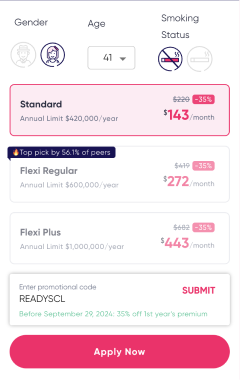
VHIS accepts newborns as young as 15 days old for coverage, and premiums can enjoy tax deductions. For example, for a 0-year-old male or female infant subscribing to Bowtie’s VHIS Flexi Plan (Regular), the monthly premiums as low as $361 and $350 respectively.
In addition to newborns, mothers covered by pregnancy insurance after giving birth might also consider switching to VHIS without pregnancy coverage to save on premiums and enjoy tax deductions.
Many medical insurance or voluntary medical insurance plans on the market exclude pregnancy or related complications, so expectant mothers may need to consider insuring themselves with products that cover these items.
Bowtie’s latest offering, Bowtie Children’s Growth Term CI , in addition to covering various pregnancy complications and protecting expectant mothers, also accepts pregnant women between 18 and 31 weeks of pregnancy for coverage (provided they have completed a structural scan with no abnormalities in the report), offering lifelong coverage up to HK$500,000 for the unborn baby.
Features of Bowtie Children’s Growth Term CI include:
After children reach adulthood, parents can switch their coverage to Bowtie Critical Illness Insurance to provide enhanced protection for their children!
There are many critical illness insurance products on the market specifically designed to protect unborn babies and pregnant women, such as the newly launched Bowtie Children’s Growth Term CI Insurance, which accepts single pregnancies between 18 and 31 weeks (provided the structural scan has been completed with no abnormalities in the report).
In addition to covering various pregnancy complications, it also protects against potential congenital and genetic diseases that may occur after the baby’s birth, filling gaps in existing medical coverage.
Bowtie Children’s Growth Term CI provides coverage for the pregnant mother, and after the baby is born, the coverage transfers to the baby. In other words, as long as the pregnant mother subscribes to Bowtie Children’s Growth Term CI during pregnancy, the baby can receive critical illness coverage after birth *^ !

© 2025 Bowtie Life Insurance Company Limited. All rights reserved.