Author
Bowtie Team
Updated on
2025-07-22
Disclaimer: This article is translated with the assistance of AI.
The “Flexi Plan” is a reimbursement-based medical insurance product. We designed the “Flexi Plan” with the goal of providing the maximum coverage at the most affordable premium, striking a “just right” balance between “price” and “coverage.” This ensures that in “most situations,” the insured can access necessary medical services for their condition without imposing heavy and unnecessary financial burdens on themselves or their family.
We quantify the above goal as an 80% “reimbursement rate 2 ” (meaning the policyholder/insured needs to pay 20% of the medical expenses out-of-pocket), but keep in mind:
| Personal Choice | Actual “Reimbursement Rate” for Serious Illnesses |
| Higher-priced private hospital + higher ward level | Decreased |
| Lower-priced private hospital + basic ward level/public hospital | Increased |
As for some non-emergency but life-impacting medical conditions , such as cataracts, ear diseases, sciatica, etc., public hospitals generally have waiting times ranging from 3 months to 3 years. For these medical situations, clients without medical insurance who need to self-pay for treatment at private hospitals but can’t afford the related costs have no choice but to endure the pain and wait for public hospitals.
There was a recent report about a patient with sciatica who was “in so much pain that tears were streaming,” unable to endure the 3-year public hospital wait and considering borrowing money to undergo surgery at a private hospital 3 , showing how these conditions can truly distress patients.
For the above situations, the “Flexi Plan” is the best choice, as it can cover most private hospital treatment costs while saving the time of waiting at public hospitals and enduring pain.
Another category of illnesses is cancers requiring long-term treatment , and VHIS is particularly helpful for long-term treatments: Unlike cancer insurance products in the market, VHIS’s non-surgical cancer treatment coverage limit is calculated “per policy year,” meaning the insured can “reset” their limit every year.
For example, cancer cells typically develop drug resistance after about a year, so the insured may need to switch to several other targeted drugs, meaning the treatment can last for several years or more. Compared to the “per cancer limit” in general cancer insurance products, VHIS’s “HK$80,000 per year” can reimburse more for long-term treatments, providing more adequate protection for the insured.
Of course, for very serious and urgent illnesses , such as late-stage cancer, the Flexi Plan might not cover all medical expenses. However, these emergencies are often prioritized in public hospitals, without the long waits like in the case above. Plus, many Hong Kongers already have cancer-specific insurance, and we wanted to avoid overlapping with existing coverage through VHIS (reimbursement medical insurance). That’s why we launched a dedicated cancer treatment insurance product separately, while the Flexi Plan provides sufficient compensation for less severe cases as described.
With this in mind, we designed the Flexi Plan with “just right” coverage items and limits, trimming excessive or unnecessary protections. We also recognized that some benefits could be easily misused, raising premiums for everyone and unfairly penalizing responsible users, so we aimed to plug those gaps.
Beyond that, we referenced market products to make adjustments, ensuring Bowtie customers get coverage levels comparable to the market. These benefits focus on the insured’s comfort or recovery, and their absence wouldn’t threaten life. So, when including them in the Flexi Plan, our key condition was that they wouldn’t significantly impact premiums.
The sections below illustrate each type of coverage item with examples:
We reviewed actual hospital charges and claims data to fine-tune commonly used benefits, ensuring the Bowtie VHIS Flexi Regular covers reasonable and customary medical fees adequately. These are often “passive” risks, where the insured can’t control frequency or severity, so we cover them comprehensively—including tail risks (rare but severe)—without overly hiking premiums. The example below on “Accident Emergency Outpatient Treatment” shows how Bowtie VHIS Flexi meets the needs of insureds and policyholders.
Example: Accident Emergency Outpatient Treatment
Accidents aren’t uncommon, and after one, you might need emergency outpatient care. But outpatient treatment isn’t covered under the VHIS Standard Plan (except for day-case procedures and pre/post-hospitalization care). We wanted to protect against these surprises, so we added accident emergency outpatient coverage with a $8,000 annual limit per policy year.
Data shows each emergency outpatient visit costs about $3,000 to $4,000 (including suturing , X-rays, and casts). Probability-wise, from tens of thousands of claims over 5 years, fewer than 0.1% of insureds claimed more than once in a year for accident outpatient. Since insureds can’t control passive risks, we based it on the 99.9% occurrence rate (1 time) plus 1, setting 2 accidents as the standard. Thus, the $8,000 limit ensures that even if you’re unlucky with one accident in a year, you won’t lose coverage entirely.
“Discretionary use” coverage items refer to: Those where the insured has some control over the frequency, timing, etc., making them prone to misuse, which could drive up overall premiums and be unfair to customers who use the product reasonably. Below, we’ll use “ward and hospital accommodation” and “prescribed diagnostic imaging tests” as examples.
Example 1: Ward and Hospital Accommodation
We’ve slightly increased the coverage limit from the VHIS Standard’s daily $880 to $1,100, roughly the median among other companies’ Flexi Plans.
Comparing charges for standard wards at 11 private hospitals, this enhanced limit fully covers 10 of them 4 , so we believe $1,100 per day is sufficient. Plus, the Hong Kong Federation of Insurers’ 2017 medical claims survey shows the average hospital stay is just 3 days. For the one hospital where it falls short, assuming a 3-day stay, you’d only need to pay $240 out-of-pocket —totally affordable. Even if medical insurance doesn’t fully cover ward and accommodation in rare cases, the self-pay amount won’t be excessive.
Looking at medical insurance claim complaints, unreasonable hospital meal cases are all too common. These are especially prevalent in high-end or higher-limit plans. For instance, a 3-year-old boy once ordered tons of food during a 3-day stay, including 5 bowls of Chinese soup, 3 sandwiches, 3 bowls of congee, steak pasta, fried rice, Chinese and Western dinners, steak dinner, totaling about $1,000. No surprise, the Insurance Claims Complaints Bureau ruled these as unreasonable medical expenses 7 . Raising limits could lead to more abuse, inflating average payouts and premiums, ultimately unfair to other customers. That’s why we’ve set the limit here—to prevent misuse by some insureds or policyholders.
Example 2: Prescribed Diagnostic Imaging Tests
The VHIS Standard’s annual $20,000 limit basically covers just one pricier test (like a full-body PET-CT scan at Union Hospital, costing up to $18,400 8 ). Our medical team believes insureds typically need at most 2 tests per year under normal circumstances. Since this is a discretionary risk, we’ve directly doubled it to $26,000, enough for 1 PET scan and 1 CT scan, ensuring fairness for all policyholders. Here’s an example:
Baptist Hospital Scan Charges
| Scan Type | Charge | Reimbursement Amount | Remaining Coverage Limit |
| PET-CT Scan (Full Torso) 9 | $18,400 | $12,880 | $13,120 |
| MRI Scan (Full Abdomen, Scan + Contrast) 10 | $9,500 | $6,650 | $6,470 |
As mentioned, 2 tests are usually plenty. Since VHIS covers outpatient tests, usage might be higher, and boosting limits could significantly impact premiums. With that in mind, we’ve avoided over-inflating the limit to provide reasonable coverage at a reasonable premium.
We’ve also referenced market product designs for Flexi Plans to stay competitive, as long as it doesn’t overly affect premiums.
Example: Post-Discharge Home Nursing Daily Benefit
After discharge, insureds might still need to visit hospitals or clinics for medical or nursing services, like wound care , injections, etc.—especially common in older insureds. We want to offer a better recovery environment: instead of tiring trips to the hospital, why not hire a qualified nurse for home visits?
Most Flexi Plans offer this. We’ve set our limit based on the market: $500 per day is about the median and won’t spike premiums much.
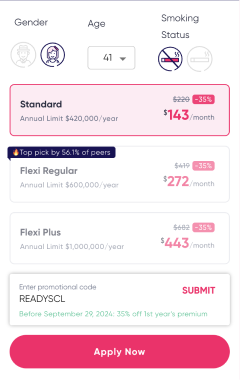
Bowtie’s VHIS “Flexi Plan” aims to provide “just right” coverage with affordable premiums, and the Bowtie VHIS Flexi Regular coverage can precisely serve as an entry point for the general public to obtain medical protection. For clients with higher financial capability who value privacy more and wish to stay in higher-end room types, ” Bowtie VHIS Flexi Plus ” is another option worth considering.

© 2026 Bowtie Life Insurance Company Limited. All rights reserved.