Medical Check Ups
Medical Check Ups

Contrast Agent: Need It for CT/MRI? Uses, Side Effects, Costs

Author Bowtie Team
Updated on 2025-07-29


Disclaimer: This article is translated with the assistance of AI.

Contrast agents are commonly used in advanced imaging like CT or MRI scans, but adding them can bump up costs by thousands. When do you really need them? Join the Bowtie Medical Info Team to explore their benefits, potential side effects, and key considerations for a smarter health choice.
~Exclusive Blog Offer~
Sales Up To 65% first year's premium!
Save up on your first year's premium now until Jan 2! (Enjoy extra coverage with our wellness package for just HK$100/month in the first year!)

What is Contrast Agent?

When doctors need to understand what’s happening inside a patient’s body, they often request imaging tests like X-rays, ultrasounds, CT scans, or MRIs. Contrast agents (also known as contrast media) are used to enhance the diagnostic value of these imaging exams.

Before the imaging diagnosis, the contrast agent is introduced into the body, making certain structures or tissues appear different on the images compared to without it. This helps distinguish specific areas of the body from surrounding tissues and assists doctors in diagnosing conditions by improving the visibility of particular organs, blood vessels, or tissues.

Contrast agents enter the body in ways including:

  1. Oral (taken by mouth)
  2. Enema (via the rectum)
  3. Injection into blood vessels (veins or arteries; also known as intravenous or arterial injection)
  4. Injection into body spaces

Common Types of Contrast Agents

1. Radiopaque Contrast Agents (for X-rays and CT)

This is a substance that absorbs X-rays, appearing white on X-ray images. It’s commonly used for contrasting:

  • Blood vessels: The agent can be injected intravenously into the vascular system to help detect vessel shapes and blood flow.
  • Inside the digestive tract, biliary tract, and urinary tract: The agent can be taken orally, via enema, or other methods to examine lesions or abnormalities inside these tracts.
  • Blood flow in organs: The agent can be injected into vessels to observe blood flow in organs like the heart, lungs, and kidneys.

These agents typically contain iodine or barium.

2. Paramagnetic Contrast Agents (for MRI)

Commonly used to improve contrast between different tissues in magnetic resonance imaging (MRI), they achieve this by altering the magnetic properties of particles, making MRI images clearer. These agents usually contain gadolinium.

Risks of Contrast Agents

Contrast agents are safe medications, and while adverse reactions can range from mild to severe, serious ones are extremely rare.

Allergic Reactions

If you have the following conditions, you may have a higher risk of allergic reactions to contrast agents:

  • Previous reaction to the same contrast agent
  • Moderate or severe allergic reactions to 4 or more foods or medications that cannot be treated solely with Benadryl. Allergic reactions include difficulty breathing or facial swelling.
  • Current asthma symptoms
Moderate Allergic Reactions Severe Allergic Reactions
Hives (over 12 years old), rapid breathing, wheezing, facial swelling, and throat tightness without shortness of breath Low blood pressure, rapid heartbeat, wheezing with shortness of breath, swelling of the throat and airways, difficulty breathing

Kidney Damage

Patients with impaired kidney function should be especially cautious before injecting iodine-containing contrast agents. While many agents are safe for kidney patients, if you have severe kidney disease with very poor function, using iodine contrast may increase the risk of worsening kidney function.

Cost of Contrast Agents

Taking Gleneagles Hospital outpatient charges as an example, the difference in diagnostic fees with and without contrast agents is as follows:

CT Scan

Body Part Without Contrast With Contrast
Head $2,970 $5,220
Urinary System $4,230 $9,900
Chest and Full Abdomen $10,350 $17,820

MRI Scan

Body Part Without Contrast With Contrast
Brain, Orbit, Paranasal Sinuses, Neck/Nasopharynx $7,990 $12,900
Upper Abdomen, Pelvis $8,550 $13,140
Limb/Joint (Unilateral) $8,280 $12,960

The maximum fee difference with and without contrast agents can reach $7,500 , and for some items like urinary system CT, the charges can differ by about 2.3 times .

  • * The above fees are effective from January 2024, collected and updated by the Bowtie Medical Information Team on February 5, 2024

Can You Skip Contrast in CT or MRI Scans?

Not all imaging diagnostic tests require contrast agents. In fact, over 85% of MRI scans don’t need them at all.

Take MRI scans, for example: Using contrast-enhanced magnetic resonance imaging (MRI) can detect smaller tumors and better assess their size and how much they’ve spread to surrounding tissues.

Can Patients Decide on Using Contrast?

Hospitals or clinics decide based on the area being scanned, medical history, and the attending doctor’s requirements whether to inject intravenous contrast for more diagnostic data. However, patients have the final say.

Is Contrast Safe for Breastfeeding Moms?

CT scans with intravenous contrast are safe for breastfeeding women, as only about 0.5% of the contrast dose ends up in the mother’s milk.

Hospitals recommend pumping enough milk for 24 hours before the injection for feeding. Breastfeeding moms can wait until the contrast is excreted through urine before resuming nursing.

Claim VHIS for Scan Expenses Easily!

CT Scans, MRI Scans, and PET Scans are common checks. While general medical insurance covers them, it often requires:

  • Must be done during hospitalization ; and
  • Diagnosis of a disease from the scan; or
  • Already diagnosed with a disease and using the scan to monitor it

In contrast, VHIS has no such limits. If a doctor deems these 3 “diagnostic imaging tests” medically necessary, you’ll get reimbursed! Check out the coverage and limits now:

  1. Key Notes for Getting Reimbursed

Since VHIS only covers medically necessary scans, you might need a referral letter or a statement from your attending/registered doctor on the claim form.

  1. Claims for Scans at Clinics, Day Surgery Centers, or Hospitals

Under VHIS , scans at day surgery centers or hospitals are covered. Most Bowtie VHIS plans even offer “cash benefits” for ” day surgeries “.

Bowtie VHIS Standard Bowtie VHIS Flexi (Regular / Plus) Bowtie Pink (Semi-Private / Private)
Cash Benefit X HK$800–1,300/surgery HK$800/surgery
Learn More Learn More Learn More
  1. Bowtie VHIS Coverage for Diagnostic Imaging

Bowtie VHIS Standard Bowtie VHIS Flexi (Regular / Plus) Bowtie Pink (Semi-Private / Private)
Coverage Limit HK$20,000/year HK$26,000 – 40,000/year Full Reimbursement*
30% Co-insurance X
Deductible (HK$0 to 80,000) X X
Learn More Learn More Learn More
  • * Full reimbursement means no sub-limit on compensation and applies only to specified benefit items. Payable compensation is subject to the remaining deductible (if applicable), annual benefit limit, lifetime benefit limit, and other restrictions including reasonable and customary charges, pre-existing conditions, designated hospital list in Mainland China, and treatments in the US, etc. For detailed terms and conditions, product risks, and exclusions, please refer to the relevant product website and policy.


How Does “Co-Insurance” Affect Your Claim Amount?

“30% co-insurance” means VHIS will cover 70% of the costs, while the remaining amount is subject to the annual benefit limit. Take Bowtie VHIS Standard as an example, the annual limit is HK$20,000.

How to Get Full Reimbursement? Bowtie Pink Helps!

Offset Bowtie Pink VHIS Deductible with Company Medical

Bowtie Pink (Semi-Private/Private) is a high-end VHIS plan with a deductible .

By using ” company medical insurance ” to offset the “deductible”, the insured can get full reimbursement* for “diagnostic imaging tests”, as the plan has no ” co-insurance “. Check your employer’s company medical insurance—if the group plan also covers “diagnostic imaging tests” with a limit over HK$20,000, you can enjoy full reimbursement!

Of course, if you don’t have company medical insurance, you can choose the HK$0 deductible Bowtie Pink VHIS plan for easy full reimbursement* .

  • * Full reimbursement means no sub-limit on compensation and applies only to specified benefit items. Payable compensation is subject to the remaining deductible (if applicable), annual benefit limit, lifetime benefit limit, and other restrictions including reasonable and customary charges, pre-existing conditions, designated hospital list in Mainland China, and treatments in the US, etc. For detailed terms and conditions, product risks, and exclusions, please refer to the relevant product website and policy.


How Does Deductible Affect Your Claim Payout?

Suppose the “diagnostic imaging test” costs HK$19,000, but the deductible is HK$20,000 – the insurer won’t cover anything.

Get Instant Personalized VHIS Quote

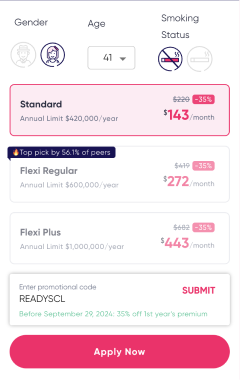
Bowtie offers a premium calculator to help you estimate your monthly VHIS expenses based on age, gender, smoking habits, and more:

Bowtie Pink VHIS Plan Calculator

Bowtie Pink Blog Promo!

Tired of sky-high private hospital bills but hesitant about purchasing VHIS? Bowtie Pink provides full coverage*, with long-term premiums are substantially lower than market rates^.

For a limited time, use the exclusive Bowtie Blog promo code【BLOGENGINSURE】to get an impressive 65% in first year’s premium and secure top-tier health protection at an unbeatable price!


*Full coverage shall mean no itemized benefit sub-limits, and applies to designated benefit items only. The benefit payable shall be subject to the remaining deductible (if applicable), annual benefit limit, lifetime benefit limit and other limitations such as reasonable and customary charges, a pre-existing condition, “List of Designated Hospitals in Mainland China” and receiving medical treatment in the United States. For detailed terms and conditions, product risks, and exclusions, please refer to the relevant product website and policy.
^For example, with Bowtie Pink (Ward) and the deductible option HK$80,000, the monthly premium for a 30-year-old non-smoker is HK$197. The premium comparison above is based on similar medical insurance plans with the ward level (data source on 27, July 2023), HK$50,000 to HK$80,000 deductibles, for a 30-year-old non-smoker. Different medical insurance plans have different coverage and benefit limits. For details, please refer to the relevant insurance policy and its terms and conditions.


Related Articles

Positron Emission Tomography (PET Scan) : Hospital fee references and VHIS Reimbursement Guidelines Positron Emission Tomography (PET Scan) : Hospital fee references and VHIS Reimbursement Guidelines
Medical Check Ups

Positron Emission Tomography (PET Scan) : Hospital fee references and VHIS Reimbursement Guidelines

Urinalysis: What could be tested? Summary on Procedures and report (Cost included for Ref.) Urinalysis: What could be tested? Summary on Procedures and report (Cost included for Ref.)
Medical Check Ups

Urinalysis: What could be tested? Summary on Procedures and report (Cost included for Ref.)

What is an ECG? How to monitor heart rate? A guide to understanding electrocardiograms! What is an ECG? How to monitor heart rate? A guide to understanding electrocardiograms!
Medical Check Ups

What is an ECG? How to monitor heart rate? A guide to understanding electrocardiograms!

Enter Promo Code [BLOGENGINSURE] when purchasing VHIS on or before 2 Jan to enjoy 65% off first years' premium!
Quote now

Other Topics

Email

General Enquiry
hello@bowtie.com.hk
Media Enquiry
media@bowtie.com.hk
Partnership
partner@bowtie.com.hk

© 2025 Bowtie Life Insurance Company Limited. All rights reserved.
Your Browser is outdated. To have a better user experience, please upgrade or change another browsers. OK