Author
Bowtie Team
Updated on
2025-07-10
Disclaimer: This article is translated with the assistance of AI.
BK netizen “MLOVEL” shares that she’s about to become a full-time mom and needs to trim family expenses, so she’s considering canceling her baby’s medical insurance. She mentions her baby was treated in a public hospital and she was satisfied with the diagnosis and care; another netizen “Huuu” points out that medical insurance premiums keep rising, and as a part-time working mom, it’s getting tough, leading her to think about dropping her hospitalization coverage.
Both netizens are eyeing policy cancellation to save on household costs, but does ditching medical insurance actually lead to real savings?
Many might agree with “MLOVEL” that kids or family members can always head to public hospitals if they get sick, even without insurance. But let’s face it, the public healthcare system is often overwhelmed—that’s no secret. While her child had a positive experience, there’s no guarantee it’ll happen every time, especially during flu season when emergency room waits or hospital admissions could drag on longer than you’d imagine, putting extra strain on staff.
Plus, kids often need more monitoring than adults, like for high fevers or persistent vomiting. A smarter move might be opting for private hospitals for quicker, tailored care. Without medical insurance, parents would shoulder all the risks and costs, which could easily run into tens of thousands of Hong Kong dollars for hospitalization; and if surgery is needed, you’re looking at six figures or more.
That said, “Huuu” has a point—healthcare inflation is skyrocketing worldwide, and premiums rising year after year is just the reality. If you want solid coverage without breaking the bank, you don’t have to cut your policy entirely. Consider direct-to-consumer options like VHIS products, as they often offer great value without the middleman markup.
BK netizen “hong_yau” explains his decision to cancel a policy, noting he’s been paying premiums for 16 years on a savings life insurance with hospitalization coverage, totaling about $140,000. Now, surrendering it would only return over $40,000. He feels it’s mostly because the medical insurance “ate up all the money.” After reviewing his premium report, he points out that medical costs made up around $50,000 of the total, and since he’s never made a claim, he thinks it’s a raw deal.
First off, it’s worth clarifying that medical insurance is essentially a consumption-based product, so saying it “ate up all the money” might be a bit unfair. As he mentioned, no one really wants to file a claim—never needing hospitalization or surgery is actually a blessing in disguise.
In reality, the bigger drain is likely from the savings component of the life insurance, especially since he highlighted the life coverage was minimal and he’s choosing to cash out early.
At the end of the day, for the best bang for your buck, go for straightforward options like Term Life Insurance without any savings elements. This way, with the same premium, you get more robust life coverage compared to savings-tied policies. As for medical insurance, if he doesn’t have another one, I’d recommend getting one while he’s still healthy. After all, health risks are a constant from birth to old age. If value is your priority, direct-to-consumer VHIS is the way to go—it skips agent commissions and cuts operational costs, keeping premiums more affordable.
LIHKG user “Freezeeeee” and BK netizen “kaka_88” both bring up frustrations with insurance agents. The former bought medical insurance through a broker, but the policy turned into an orphan policy , and when he needed help with a colonoscopy claim, the company’s customer service couldn’t provide clear guidance without the broker’s assistance, making him consider canceling and switching. The latter says his agent turned cold after the sale of VHIS, no longer as helpful or easy to reach as before, which has him thinking about ditching the policy.
The idea behind agents is to help with everything from signing up to claims and policy management. If your agent has left or isn’t holding up their end, and you can secure new coverage, then dropping the old policy might make sense. With direct-to-consumer insurance now available, switching to agent-free options is worth considering.
Take Bowtie, for example—we stick to a “help without the hard sell” philosophy. No agents doesn’t mean no service; in fact, we prioritize customer service . Our team handles queries via hotline and WhatsApp, and for claims, you can directly connect with claims specialists for advice. Without commissions, our advisors focus on your needs, offering unbiased product recommendations.
A LIHKG user nicknamed “ou University Student,” who works in a high-risk job, once posted about buying insurance through a bank cold call. He mentioned that the policy involves paying for 8 years and getting 8 years free, allowing him to recover the full premium after 16 years. However, it only compensates HK$300,000 for accidental death. After paying for over 8 months, he feels he got scammed (likely because the coverage scope and amount are insufficient) and is considering canceling the policy to switch to other insurance options.
Based on the policy’s feature of fully recovering premiums after the payment period and its protective nature, it seems to be primarily a savings-focused plan with accidental death coverage as a secondary benefit. The user himself pointed out that the accidental death payout is too low. From a savings perspective, this policy will only return the principal after 16 years, which means it will definitely lose to inflation. So, it’s wise for him to cancel this policy and switch to other options, such as purchasing a pure protection plan like Term Life and Accident Insurance , while handling savings and investments separately—for instance, the simplest approach: setting up a bank fixed deposit for interest.
A LIHKG user nicknamed “Shut Up, Meddling Man” posted that she bought medical and pure critical illness policies years ago. With her company’s health insurance providing solid coverage and premiums rising yearly, she’s thinking about canceling her medical policy and keeping only the critical illness one.
In reality, even if your company’s health insurance is comprehensive and has high limits, you’ll lose that coverage during job transitions or after retirement, creating a “coverage gap.” If health issues arise during that time, you’d have to shoulder the hefty medical costs yourself. Plus, as we age post-retirement, health problems tend to crop up more often, and it’s uncertain whether you’d pass an insurer’s underwriting to get new coverage.
Here’s a smart move for her: Even if she decides to drop her current medical policy, she could switch to a high-end Voluntary Health Insurance plan with a deductible option that offers full reimbursement. This way, she can make the most of her company’s benefits while cutting costs.
To save even more on premiums, we suggest considering a reduction in the critical illness insurance coverage amount . Her current HK$30 million limit is quite high for the average employee (a general rule is to aim for 2–3 times your annual income). If her existing critical illness policy can’t be adjusted, she might opt for a new term critical illness policy, then cancel the old one once the new one kicks in.
A LIHKG user nicknamed “Peanut and Walnut Milk” asked if it’s okay to cancel a policy right after a successful claim. Although he didn’t specify the type of insurance, policies like medical, accident, or critical illness are designed for long-term protection against illnesses or injuries. Even after one or more claims, there’s no real reason to cancel unless the policy isn’t “guaranteed renewable” and the insurer hikes premiums or refuses renewal based on your claim history.
Jumping to cancel could leave you unprotected if health issues pop up later, like needing hospitalization or surgery—you’d end up paying all costs out of pocket. Plus, canceling right after a payout might make it seem like you’re treating insurance as a quick gamble rather than the risk-hedging tool it’s meant to be.
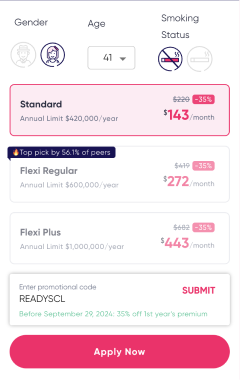
If you think your current insurance premiums are too high or the coverage isn’t comprehensive enough, you might consider Bowtie VHIS series , Bowtie Term Life , Term CI .
Bowtie has a dedicated customer service team with no intermediaries, so you won’t have to pay those sky-high commissions. Plus, by using tech to ditch the old-school hassles of policy applications, underwriting, approvals, and management, we keep premiums at a level that’s easy on the wallet—making our products a real bang for your buck.

© 2026 Bowtie Life Insurance Company Limited. All rights reserved.