Author
Bowtie Team
Updated on
2025-12-29
Disclaimer: This article is translated with the assistance of AI.
People over 60 may already be grandparents or great-grandparents. For this age group, medical insurance is the most essential type. If seniors have retired, they likely no longer have company medical insurance, so they must rely on their own coverage to handle medical expenses. Without medical insurance, they would have to use their savings, which could impact their retirement financial planning.
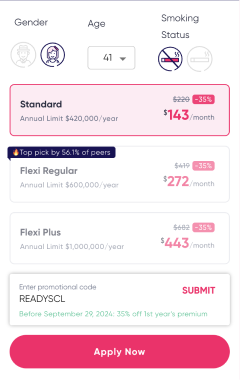
If the budget is limited, consider starting with a basic medical plan, such as the Standard Plan , to get essential medical coverage. Even if this option doesn’t cover all medical costs (such as for cancer), it at least provides an additional choice for seniors to decide on the appropriate treatment.
If you have a more generous budget, consider higher-coverage options or plans with no item limits and full reimbursement, such as high-end medical insurance , to strengthen protection.
For working adults, various types of insurance play a role in maintaining family financial health and risk management, with medical insurance remaining the most important. Considering that employed individuals may have company medical insurance, you can select a suitable medical plan to supplement any gaps, for example, one with a deductible (also known as deductible ) like high-end medical insurance .
Additionally, working adults may also consider critical illness insurance and term life insurance , which can offset financial losses from unfortunately contracting a critical illness or passing away.
If the budget allows, parents should choose medical insurance with semi-private room coverage for children. This is because many private hospitals require children with illnesses (especially infectious diseases) to stay in single or at least semi-private rooms to prevent cross-infection.
Furthermore, injuries from play and sports are common for children , so accident medical insurance is also very important, as it can effectively cover outpatient or inpatient costs that might amount to over ten thousand dollars.
Plans with no item limits and full reimbursement, such as high-end medical insurance , can provide the most appropriate medical support if a family member unfortunately falls seriously ill. If high-end medical insurance exceeds your budget, when selecting other medical products, pay special attention to whether the coverage for individual items is sufficient or if there are supplementary medical coverage (SMM) options to cover all or part of any excess amounts.
Overall, private hospitals in Hong Kong offer high service levels, but fees vary, with some hospitals charging up to 30% more than others . Consumers should check if the coverage level of their chosen medical insurance, such as room type and reimbursement limits, is sufficient to cover common surgery fees at preferred institutions.
Additionally, as mentioned earlier, many private hospitals may require children in certain situations to stay in lower-density rooms. In such cases, standard room-level insurance may not fully reimburse the final costs, leaving parents to pay the excess themselves.
If your company medical insurance is insufficient, you can use a plan with a deductible to enhance coverage. Generally, plans with a deductible have the same coverage but lower premiums, allowing you to get top-up protection economically.
Medical insurance premiums typically rise with age, and insurers may adjust them based on medical inflation and other factors. Since medical insurance is a long-term expense spanning decades, it’s wise to compare options before purchasing. A smart choice could save you and your family hundreds of thousands in premiums over the years.
Not all medical insurance qualifies for tax deductions. Only voluntary health insurance (VHIS) plans allow you to claim tax deductions , with a cap of $8,000 per insured person.
How much tax can a family save by purchasing VHIS ? Refer to the following example: Mr. Wong insured a family of four and saved $2,580 in taxes:
| Mr. Wong 👨🏼🦲 | Mrs. Wong 👩🏽 | Son 👦🏽 | Daughter 👧🏽 | |
| Annual Actual Premium Paid | $4,284^ | $5,676# | $2,436* | $2,784@ |
| Premium Eligible for Tax Deduction | $4,284^ | $5,676# | $2,436* | $2,784@ |
| Tax Deduction Amount (Assuming a tax rate of 17%*) | $4,284 x 17% = $728 | $5,676 x 17% = $965 | $2,436 x 17% = $414 | $2,784 x 17% = $473 |
| Final Annual Expense (Actual Premium Paid – Tax Deduction Amount) | $4,284 – $728 = $3,556 | $5,676 – $965 = $4,711 | $2,436 – $414 = $2,022 | $2,784 – $473 = $2,311 |
^The standard premium for a 40-year-old, non-smoking male insured with the Bowtie VHIS Flexi Regular is used for calculation
#The standard premium for a 40-year-old, non-smoking female insured with the Bowtie VHIS Flexi Regular is used for calculation
*The standard premium for a 20-year-old, non-smoking male insured with the Bowtie VHIS Flexi Regular is used for calculation.
@The standard premium for a 20-year-old, non-smoking female insured with the Bowtie VHIS Flexi Regular is used for calculation.
In the past, buying medical insurance typically involved purchasing through intermediaries from traditional insurers, which offered benefits like product explanations and after-sales follow-up. However, if you encounter poor after-sales service or the intermediary leaves, your policy might become an orphan policy , making it difficult for the policyholder to handle claims independently.
In fact, virtual insurance companies now offer online services for quoting, purchasing, policy management, and claims, all done self-service via computer or phone. Those looking to buy can research and compare on their own, avoiding aggressive sales tactics. For consumers, this advanced insurance model might be a better choice.
Therefore, if you are unfortunately diagnosed with a critical illness, having only medical insurance may cover your medical costs but may not address the long-term challenges you face. In reality, a critical illness diagnosis, even if not fatal, often forces you to stop working and lose income, which can affect your quality of life and disrupt your existing plans.
Since medical insurance and critical illness insurance provide complementary coverage, a reliable critical illness insurance policy can replace your lost income during your absence from work, providing financial support and reducing the impact on your family, while maintaining your original quality of life.
Moreover, even if you cannot purchase new insurance after an illness, the critical illness payout can help you continue paying for your existing medical insurance premiums when necessary.
Critical illness insurance is absolutely an essential form of protection. In addition to medical insurance, the importance of critical illness insurance cannot be overlooked. In any situation, as long as you have a stable income, you should seriously consider purchasing a critical illness policy to provide an extra layer of protection.

© 2026 Bowtie Life Insurance Company Limited. All rights reserved.