Reversionary Bonus Explained: Face Value, Cash Value and Payouts

What is a reversionary bonus?
Check future declarations, declared face value and surrender cash value separately.
Key takeaways
- Future bonuses are not guaranteed.
- Declared face value is generally fixed for the death benefit; surrender cash value can be lower.
- Maturity payment rights depend on the contract.
- Terminal bonuses can change until payable.
- Fulfilment ratios describe past results, not future promises.
A reversionary bonus adds to the benefits of a participating, or “with-profit”, life policy. Future bonuses are not guaranteed.
Once declared, the bonus’s face value is generally fixed and payable on death. Its cash value on surrender is not guaranteed and is usually lower. Maturity and other payment rights depend on the contract.
- The insurer reviews investment results, claims, expenses and lapses.
- It may declare a bonus as an amount or a percentage under the policy’s rules.
- The declared bonus attaches to the policy.
- Future declarations may be lower or zero.
Source: the Insurance Authority’s dividend definitions. The Insurance Authority (IA) regulates Hong Kong insurers.
Reversionary bonus vs cash dividend vs terminal bonus
The main differences are when you can receive the benefit and which value becomes fixed.
| Feature | Cash (annual) dividend | Reversionary bonus | Terminal bonus |
|---|---|---|---|
| How it is declared | Each year, as cash | Each year, added to the sum assured | Announced periodically; paid once |
| Can you withdraw it during the policy? | Yes, or leave it to accumulate | Usually only by surrendering the bonus at its cash value | No – only when the policy ends |
| What you receive | Cash dividends left in the policy plus applicable interest | Face value on death; maturity terms depend on the contract | Amount determined when payable |
| Guaranteed? | Future dividends: no. Declared cash amount: generally fixed. | Future declarations: no. Declared face value: generally fixed. Cash value: not guaranteed. | No |
| Volatility | Future declarations and interest can change | Future declarations and surrender cash values can change | Can change until payable; no universal ranking across products |
Check the investment strategy and target asset mix in the brochure. A bonus label alone does not establish the return or risk. Read cash value and dividends for the wider picture.
When can you receive a reversionary bonus?
The amount depends on the event and the policy terms.
- On death: the death benefit may include the bonus’s full face value and any terminal bonus due.
- On maturity: check whether the policy has a maturity date and which bonus value is payable.
- On full or partial surrender: the cash value may be lower than face value. Check whether bonus surrender is allowed and whether a terminal amount is due.
Example: Kelvin’s face value and cash value
Kelvin has HK$100,000 of declared bonuses at face value. Assume the contract pays that face value on death but values it at HK$60,000 on surrender.
| Event | Bonus amount in the example |
|---|---|
| Covered death claim | HK$100,000 added under the death-benefit formula |
| Surrender | HK$60,000 cash value |
The insurer determines surrender cash value under the contract. Do not treat the face value as cash you can withdraw today.
How can bonuses increase the death benefit?
Declared bonuses can add to death cover. A simple bonus may use the basic sum assured; a compound bonus may also use earlier bonuses. The policy defines the basis.
| End of year | Sum assured | Accumulated reversionary bonus (face value) | Death benefit before any terminal bonus |
|---|---|---|---|
| 5 | HK$500,000 | HK$50,000 | HK$550,000 |
| 10 | HK$500,000 | HK$100,000 | HK$600,000 |
| 20 | HK$500,000 | HK$200,000 | HK$700,000 |
These figures show the effect of adding bonuses, not a promised bonus rate.
Where does a terminal bonus fit?
A terminal bonus is a separate one-off amount payable when the policy ends, as the terms provide. It can change until payable.
Check how much of your intended exit-year value depends on that bonus. A large illustrated total may contain a substantial amount that is not guaranteed.
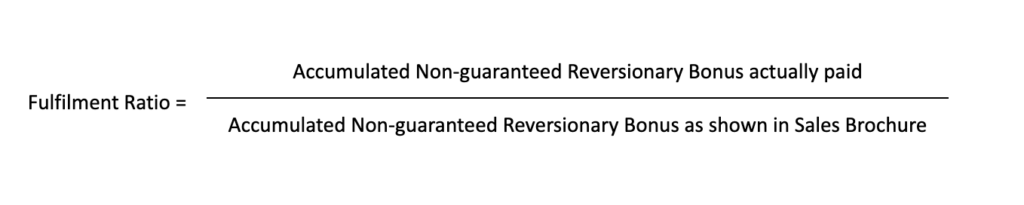
How is the fulfilment ratio calculated?
A fulfilment ratio compares actual relevant non-guaranteed benefits with the amounts illustrated at sale. For reversionary bonuses, use cash value, not face value.
Ratio = aggregate actual bonus cash value ÷ aggregate illustrated bonus cash value × 100%
- Around 100%: the relevant benefits were close to the illustration.
- Above 100%: they exceeded it.
- Below 100%: they fell short.
| Policy year | Illustrated accumulated bonus cash value | Actual accumulated bonus cash value | Fulfilment ratio |
|---|---|---|---|
| 1 | HK$1,000 | HK$900 | 90% |
| 2 | HK$2,000 | HK$1,500 | 75% |
| 3 | HK$3,000 | HK$3,000 | 100% |
In this example, both amount columns mean accumulated bonus cash value. The published ratio groups relevant policies in a product series; your individual result may differ.
Current GL16 requires disclosure for relevant series with new policies issued since 2010 and policies in force in the reporting year, unless the IA agrees otherwise. Past results do not predict future bonuses.
How should you read fulfilment ratio tables?
Read the benefit type, policy year and reporting year together.
- Check both reversionary and terminal bonus ratios. One may meet its illustration while the other falls short.
- Look across all available policy years, including later years, rather than one figure.
- Read “N/A” notes. The reason may be no relevant policies, a zero illustrated amount or no relevant terminal payouts.
- A similar product series can give context for a new plan, but is not that plan’s record.
- Keep the warning in view: past ratios do not promise future bonuses.
Use the IA’s insurer directory and interpretation guide.
What should you ask before buying?
Use the policy illustration and contract to answer these questions:
- How much is guaranteed in years 10, 20 and 30, or the years relevant to you?
- How much comes from reversionary and terminal bonuses?
- What do the ratios show across the available policy years, including years 5–10 where available?
- What bonus cash value could you receive on early surrender?
- How does the insurer set bonuses?
- What is the target asset mix?
- What happens if you stop paying premiums?
- When is breakeven, and what IRR do the guaranteed values imply?
Common mistakes
- Treating declared face value as cash in hand.
- Ignoring the non-guaranteed terminal bonus.
- Using only one year’s ratio.
- Comparing projected totals without separating guarantees.
- Choosing savings at the expense of enough death cover.
Where does term life fit?
A participating plan combines savings and life cover. If family protection is your main need, compare pure protection before deciding whether you also want savings in the same policy.
Standard term life has no cash value or bonuses and generally costs less for the same death cover. You can assess savings separately.
Bowtie Term Life offers cover from HK$200,000 with no savings element or commission. It includes yearly renewable and five-, ten- and twenty-year options. Longer-term premiums stay fixed within the chosen term and are repriced at renewal.
Compare term life and whole life around your own goals, budget and access needs.
Frequently asked questions about reversionary bonuses
Is a reversionary bonus guaranteed?
Future declarations are not. Declared face value is generally fixed for the death benefit, but surrender cash value is not guaranteed. Check maturity terms separately.
How is it different from a terminal bonus?
A reversionary bonus attaches to the policy once declared. A terminal bonus is paid once when the policy ends and can change until payable.
Where can I find fulfilment ratios?
On the insurer’s website. Match the series and benefit type to your plan and read the reporting notes.
Does a high ratio mean the plan is good?
Not by itself. Check the whole record, guarantees, costs and suitability. A high past ratio is not a future promise.
Does term life pay bonuses?
Standard pure protection has no bonuses or cash value. Its purpose is death cover during the term.
Compare protection and savings separately
Work out the death cover your family needs, then get a term life quote if you want a protection-only comparison.
This article provides general information, not personal insurance, financial or tax advice. Refer to the policy documents for full terms, conditions and exclusions.
