VHIS / Medical Insurance: How Are Premiums Calculated? Do They Increase Yearly?
Where can one find comprehensive premium information for all VHIS schemes in Hong Kong?
With hundreds of Voluntary Health Insurance plans available on the market, what avenues exist to view premium details for all authorised products offered by different insurers?
In fact, simply visit the official Voluntary Health Insurance website to access the latest premium information for all authorised Voluntary Health Insurance products:
- Standard Plan
- Flexible Plan
- Glossary
How much lower are Bowtie's Voluntary Health Insurance premiums compared to similar products?
Health insurance premiums represent a long-term expenditure, so policyholders should pay attention to the long-term premium levels. While many insurers attract customers with first-year premium discounts or other short-term offers – with some discounts as low as 10% of the first-year premium – policyholders should not be swayed solely by such incentives. Instead, one should compare the long-term premium levels across different insurers and assess one’s ability to sustain these payments before committing to a policy.
To facilitate comparison, Bowtie has compiled standard and flexible plans from insurers across the market for your reference. Bowtie saves you on average annually:
- Bowtie Pink (Semi-Private Room) 5,213
- Bowtie Flexible Plan: 2,873
- Bowtie Standard Plan: 1,070
- *1 The above premium comparison data is based on market research conducted on 29 December 2025 using publicly available information. It covers medical insurance plans of the same type at the semi-private ward level with a self-pay option of HK$0 million, calculated using the basic premium for a non-smoking male aged 30-45. Coverage scope and benefit limits vary across different medical insurance plans. For details, please refer to the relevant policy documents and their terms and conditions.2 The above premium comparison data is based on market research conducted on 29 December 2025 using publicly available information. It covers standard ward-level plans with "Additional Medical Coverage" and "Room and Board" item limits of $800 - $1200. Coverage scope and benefit amounts vary across different medical insurance plans. For details, please refer to the relevant policy and its terms and conditions.3 The premium comparison data above reflects market research conducted on 29 December 2025 based on publicly available information, covering premiums for standard Voluntary Health Insurance Plans in the market. Premiums for other insurers' plans are calculated on an annual basis, using the example of a non-smoking male aged 30-45. For details, please refer to the relevant policy documents and their terms and conditions.
Are there any hidden catches with Bowtie’s low premiums?
Low premiums do not imply Bowtie will be deliberately “stingy” with claims settlements. In fact, since launching its Voluntary Health Insurance products, Bowtie has processed numerous claims cases with a successful approval rate of 98.3%^ – exceeding the overall Hong Kong Voluntary Health Insurance claims success rate of 92% to 96%# recorded from April 2019 to the end of 2023.
Source: Legislative Council documents
How much is Bowtie's Voluntary Health Insurance premium?
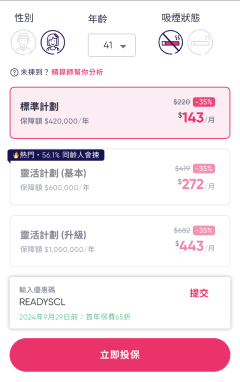
If you lack personal medical cover and have a limited budget, the VHIS Standard Plan may assist you! This plan offers annual hospitalisation cover up to $420,000, with products from different insurers offering broadly similar coverage.
The table below lists Bowtie’s Voluntary Health Insurance Standard Plan monthly premiums:
| Age | Monthly premium ( HK$ ) | |
| Non-smoking men | Non-smoking women | |
| 0 years old | $146 | $155 |
| 10 years old | $96 | $95 |
| 20 years old | $104 | $122 |
| 30 years old | $138 | $175 |
| 40 years old | $192 | $235 |
| 50 years old | $301 | $351 |
| 60 years old | $464 | $446 |
Bowtie’s Flexible Plan comes in two versions: Regular and Plus . The Regular version is for general homeowners, while the Plus version offers semi-private home protection, suitable for those who want more coverage, and is reasonably priced , making it affordable for the general public!
The table below lists the monthly premiums for non-smoking men and non-smoking women under Bowtie Voluntary Health Insurance’s “Flexible Plan” :
Non-smoking men
| Age | Monthly premium (HK$) | |
| Flexi Regular | Flexi Plus | |
| 0 years old | $388 | $739 |
| 10 years old | $195 | $350 |
| 20 years old | $203 | $342 |
| 30 years old | $254 | $453 |
| 40 years old | $357 | $647 |
| 50 years old | $546 | $1,027 |
| 60 years old | $928 | $1,715 |
Non-smoking women
| Age | Monthly premium (HK$) | |
| Flexi Regular | Flexi Plus | |
| 0 years old | $376 | $680 |
| 10 years old | $185 | $313 |
| 20 years old | $232 | $376 |
| 30 years old | $371 | $589 |
| 40 years old | $473 | $769 |
| 50 years old | $675 | $1,088 |
| 60 years old | $875 | $1,446 |
Bowtie Pink is our flagship product, offering full coverage for inpatient medical expenses with global coverage . Annual coverage ranges from HK$8 million to HK$20 million, with monthly premiums as low as HK$213 ! If you want comprehensive protection, Bowtie Pink is the perfect choice. Of course, if you have personal or company health insurance, you can also supplement it with Bowtie Pink, which offers deductibles , to further enhance your protection.
The table below lists the monthly premiums for Bowtie Pink Voluntary Health Insurance (same price for men and women, calculated based on a deductible of HK$80,000) :
| Age | Bowtie Pink Monthly Premium (HK$80,000 Deductible) | ||
| Ward | Semi-private | Private | |
| 0 years old | $147 | $268 | $489 |
| 10 years old | $141 | $230 | $427 |
| 20 years old | $174 | $253 | $470 |
| 30 years old | $213 | $312 | $580 |
| 40 years old | $285 | $386 | $648 |
| 50 years old | $429 | $647 | $1,115 |
| 60 years old | $779 | $1,026 | $1,713 |
Which VHIS offers the lowest premium?
“Market research conducted at the end of 2024 showed that, among similar online premium flexible insurance plans, Bowtie Pink Voluntary Health Insurance (Ward) had a premium lower than other plans on the market for non-smokers aged 0 to 98 (compared to the same full reimbursement, standard room, deductible tier, and coverage area).”
How are Voluntary Health Insurance premiums calculated? Do they increase every year?
There’s no need to worry unduly. Insurance companies have the opportunity to adjust premiums annually, much like electricity and transport fares, under a mechanism that allows for both increases and decreases! Before examining the reasons for premium hikes, it’s essential to understand the two main components of health insurance costs:
- Standard Premiums
- Annual Premium Adjustments by Insurers
Standard premiums are set by insurers. Taking Voluntary Health Insurance as an example, each insurer must publish premium tables for ages 0 to 100, enabling individuals to estimate future premium increases. Upon taking out a policy, most insurers determine premiums based on individual factors, including age and health risks. Annual premium adjustments by insurers may increase or decrease premiums in response to healthcare inflation, risk pooling, and claims policies.
Below we break down the four primary reasons for premium increases, helping you understand the trends and causes behind premium changes!
Reason 1: Personal Factors
1. Age
Ageing is inevitable. Even if you enjoy robust health in youth, the risk of developing illnesses increases with age. Conditions such as hypertension, diabetes, and heart disease typically emerge gradually in later life. Therefore, as policyholders age, the average health status within their risk pool deteriorates. This naturally increases demand for medical services, leading to higher overall claims payouts. Consequently, insurers charge older policyholders higher premiums.
Is it better to purchase medical insurance as early as possible?
It is worth noting that most medical insurance products on the market will refuse to cover pre-existing and known conditions. Therefore, purchasing insurance while young is not merely about seeking cheaper premiums, but because the longer one delays, the more minor health issues may arise. Should a serious illness be diagnosed later, even if one is willing to pay exorbitant premiums, no insurer may be willing to accept the application.
According to the latest figures from a US research institute, even a healthy couple aged 65 can face average healthcare costs potentially reaching US$662,156. Therefore, if you wish to plan for retirement early, you should purchase medical insurance while in good health, ensuring every medical expense after retirement remains within your control.
2. Gender – Do Women Pay Significantly Higher Premiums?
Beyond age, premiums may also differ considerably between genders. Within each age bracket, premiums for men and women may exhibit notable variations, calculated based on actual data regarding illness or accident-related hospital admissions across different age groups.
Medical research indicates that gender correlates with the incidence rates of certain conditions; for instance, men face a higher risk of acute myocardial infarction than women. Generally, female policyholders pay higher premiums than their male counterparts between the ages of 30 and 45, as this period coincides with the peak incidence of gynaecological conditions such as vaginal disorders, uterine pathologies, and ovarian issues. Conversely, between ages 46 and 55, male policyholders’ premiums become higher than females’, as this period marks a peak incidence of illness among men.
3. Personal Habits
This primarily concerns habits such as smoking and alcohol consumption. Policyholders who smoke or abuse alcohol generally suffer greater health damage and face higher illness risks.
Medical data indicates smoking is the primary cause of lung cancer and increases the risk of heart disease, stroke, and diabetes. Consequently, premiums for smokers are generally higher than for non-smokers. Excessive alcohol consumption is a major factor affecting liver function, leading to cirrhosis and even liver cancer. Therefore, premiums for heavy drinkers are also higher than for non-heavy drinkers.
4. Physical Health Status
Physical health status is a primary factor in underwriting assessments. Insurance companies consider data such as the applicant’s height, weight, existing medical conditions, treatments and surgeries undergone, and medical examinations completed. What may seem like minor issues to the general public, such as obesity or high cholesterol, are viewed very differently by insurers. These represent risk factors that could potentially lead to serious illnesses, prompting insurers to impose additional premiums or impose exclusions.
Beyond existing conditions and symptoms, recovered illnesses and past medical history are also mandatory disclosures. Another often overlooked aspect is previous health screenings. Even if no medication or follow-up appointments were required, any abnormal results from these examinations must be truthfully disclosed during the application process. Furthermore, certain conditions, such as breast cancer and colorectal cancer, have been proven to have a genetic link. Therefore, specific illnesses affecting immediate family members must also be declared.
Reason 2: Healthcare Inflation
What factors ultimately influence healthcare cost calculations?
Healthcare expenditure is shaped by diverse economic, social, and technological drivers. In essence, an ageing population, overburdened public hospitals, rising demand for private healthcare, increasing drug costs, and the introduction of novel therapeutic devices all contribute to escalating medical expenses. Furthermore, a significant surge in overseas patients seeking treatment in Hong Kong has created a severe imbalance between supply and demand in private hospitals, making price increases inevitable.
Moreover, as modern medicine advances, drug research and development costs rise accordingly. Pharmaceutical companies routinely increase prices, with new drugs and “premium medications” (particularly targeted therapies) becoming increasingly expensive. This inevitably drives up hospital treatment fees.
Given that insurers’ operational costs are primarily allocated towards claims settlements, companies annually review premiums based on fluctuations in healthcare expenditure. As medical costs have consistently risen year on year, annual increases in medical insurance premiums are indeed justifiable.
Reason 3: Risk Pooling
The extent of premium hikes also hinges on insurers’ underwriting standards. Excessively lenient underwriting means insurers cannot fully ascertain each applicant’s health status, potentially placing both healthy individuals and those with chronic conditions within the same risk pool.
A lax underwriting process also attracts less healthy applicants who know they are more likely to make claims. Yet, due to the relaxed underwriting, they take a gamble hoping to secure cover at the rates paid by healthy individuals. This is a classic example of adverse selection occurring among policyholders.
Suppose an insurance company has 1,000 customers, each paying an annual premium of $3,000. This risk pool would then amount to $3 million annually. If numerous claims are made in a given year, totalling $2 million, the risk pool would face pressure to increase premiums. Even if you have never made a claim, the insurer will raise premiums to cover the operational costs of maintaining the risk pool, effectively passing on the risk to you, the ‘low health risk’ policyholder. Conversely, if the risk pool is relatively healthy with fewer claims, the insurer may reduce premiums, creating a win-win situation.
What is the Loss Ratio?
In medical insurance, the loss ratio serves as a crucial metric during annual product pricing reviews. Generally, it is calculated as follows:
[(Medical insurance claims paid + Other insurer expenses) / Premium income] × 100
A loss ratio reaching 100 indicates that premiums are insufficient to cover expenses.
One responsibility of an insurer’s actuary is to calculate the loss ratio annually for different products across various age groups, identify reasons for any shifts in the ratio, and ensure its stability. Should the loss ratio exceed or fall below the projections made when the product was launched, the insurer is highly likely to adjust the premiums for the following year. This annual review process is commonly referred to in English as Annual Indexation.
Therefore, a responsible insurance company will take underwriting procedures seriously to ensure the risk pool remains at a healthy level.
Bowtie utilises an exclusive online underwriting system to accurately assess each applicant’s health risks, enabling us to understand their health status without requiring a medical examination. The entire underwriting process is thorough yet straightforward, with 96% of applicants completing the questionnaire within five minutes. Should any queries arise regarding an applicant’s health, a customer service representative will follow up.
Unlike traditional insurers, all of Bowtie’s underwriting procedures are conducted online. The savings in manpower and resources achieved through this process enable premiums to be kept at an affordable level for the general public.
Reason 4 for Premium Increases: Claims Policy
Similarly, “there’s no such thing as a free lunch.” Never assume that an insurer’s claims policy is inherently better simply because it’s more lenient. After all, insurance companies are profit-driven entities. The more claims paid out, the higher the operational costs, making it increasingly likely that the company will raise premiums the following year to recoup losses.
Under standard medical insurance, when an insured person develops a medical condition, they may undergo additional related tests—such as CT scans, PET scans, or MRIs—to be on the safe side. Provided these tests are deemed medically necessary by a doctor, the associated costs can be claimed from the insurer. The only issue is that the more tests an insured person undergoes, the more claims they make, and consequently, the higher their premiums become the following year.
Voluntary Health Insurance, however, stipulates that laboratory tests must be referred by a specialist to be covered. Its claims process is more rigorous than standard medical insurance, making abuse less likely and resulting in smaller premium increases.
