VHIS Tax Deduction Guide: Tips to save premiums and enjoy maximum tax benefits
VHIS Tax Deduction: HK$3.5 Billion in Premiums Deducted Last Year
The Voluntary Health Insurance Scheme (VHIS) is currently the only medical insurance in Hong Kong eligible for tax deductions. Premiums for other critical illness, life insurance, or even medical insurance plans launched before March 2019 are not tax-deductible .
According to Legislative Council data , for the 2023-24 assessment year, 24% of taxpayers applied for VHIS tax deductions, with the total eligible premiums deducted amounting to nearly HK$3.5 billion.
| Assessment Year | Percentage of Taxpayers Applying for VHIS Tax Deduction | Total Eligible Premiums Deducted |
| 2019-20 | 8% | HK$1.019 billion |
| 2020-21 | 14% | HK$1.693 billion |
| 2021-22 | 18% | HK$2.355 billion |
| 2022-23 | 22% | HK$2.987 billion |
| 2023-24
(Preliminary figures) |
24% | HK$3.480 billion |
- Source: Legislative Council Finance Committee Document 2025
If you need to purchase hospitalisation medical insurance and want to save on taxes, the Voluntary Health Insurance Scheme (VHIS) is a good choice! However, does paying an $8,000 premium mean you save $8,000 in taxes?
What is the VHIS Tax Deduction Limit?
Assuming you are a policyholder and subject to salaries tax, you can purchase VHIS for yourself or a Designated Relative . In this case, you or your family member will become the insured person under the policy, and the tax-deductible premium limit for each insured person is $8,000.
For each tax year, even if the insured person’s annual premium exceeds the limit ($9,000), only $8,000 of the premium expenditure can be declared for tax purposes. So, how much tax can you actually save?
How to Calculate VHIS Tax Deduction Amount?
VHIS Premium X Tax Rate = Tax Deduction Amount
VHIS Tax Deduction Calculation Method / Formula
Everyone’s income varies, and so do their tax brackets. Some individuals may have a tax rate of only 2%, in which case the maximum tax deduction for each insured person would be = $8,000 x 2% = $160.
If you reach the highest tax bracket of 17%, you may be able to deduct more tax. The maximum tax deduction for each insured person would be = $8,000 x 17% = $1,360.
Does buying an expensive plan to deduct more tax save the most money? Not necessarily! To save money, the focus isn’t on how much tax you deduct, but on the premium itself!
How Much Tax Can You Deduct with Bowtie VHIS?
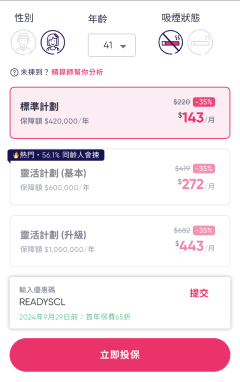
Bowtie VHIS offers various plans. For example, for a 30-year-old non-smoking male:
| Bowtie VHIS Plan | Annual Premium | Maximum Annual Tax Deduction |
| Bowtie VHIS Standard | $1,656
($138 x 12) |
$281.5
($1,656 x 17%) |
| Bowtie VHIS Flexi Plus | $5,436
($453 x 12) |
$924.1
($5,436 x 17%) |
| Bowtie Pink
(Private Room, $0 Deductible) |
$16,800
($1,400 x 12) |
$1,360
($8,000 x 17%) * The tax-deductible premium limit is $8,000. |
Tip 1: Compare VHIS Premiums!
According to the calculation method above, wouldn’t buying a more expensive VHIS plan allow for more tax deductions and savings? Indeed, a more expensive VHIS plan allows for more tax deductions, but the most cost-effective method is actually: to buy an affordable VHIS plan that offers sufficient coverage!
Let’s use the following 2 hypothetical cases to help you understand more:
- Mr. Chan 🧔🏽: Buys an expensive Bowtie VHIS Standard plan to deduct more tax!
- Mr. Wong 👨🏼🦲: Buys a Bowtie VHIS Standard plan with largely similar coverage, then applies for tax deduction!
| Mr. Chan 🧔🏽 | Mr. Wong 👨🏼🦲 | |
| Actual Annual Premium Paid | $4,104 | $1,572 |
| Eligible Premium for Tax Deduction | $4,104 | $1,572 |
| Tax Deduction Amount
(Assuming a tax rate of 17%*) |
$4,104 x 17%
= $698 |
$4,104 x 17%
= $267 |
| Final Annual Expenditure
(Actual Premium Paid – Tax Deduction Amount) |
$4,104 – $698
= $3,406 |
$1,572 – $267
= $1,305 |
From the ‘Final Annual Expenditure’ , it is clear that Mr. Wong 👨🏼🦲, by purchasing an affordable VHIS plan with sufficient coverage and then applying for tax deduction, has the ‘most cost-effective solution’ , saving over $2,000 compared to Mr. Chan 🧔🏽!
If calculated over 10 years, the savings would be even greater!
- * The ‘Actual Annual Premium Paid’ mentioned in the above example is a hypothetical figure and not the actual premium of the plan. Additionally, tax rates vary depending on individual income.
How much premium can Bowtie help you save on average each year? Compared to similar products:
- Bowtie Pink (Semi-Private) : 5,213 1
- Bowtie VHIS Flexi Regular: 2,873 2
Bowtie VHIS Standard: 1,070 3
- 1The premium comparison data above is based on market research conducted on December 29, 2025, using publicly available information. It covers similar medical insurance plans at the semi-private room level with a deductible option of HK$0, and is calculated based on the basic premiums for non-smoking males aged 30-45. The scope and amount of coverage vary among different medical insurance plans; please refer to the relevant policy, terms, and conditions for details.
- 2The premium comparison data above is based on market research conducted on December 29, 2025, using publicly available information. It covers similar VHIS plans at the general ward level with "Additional Medical Benefits" and "Room & Board" item limits of $800 – $1200, and calculates the standard annual premium for a non-smoking male aged 30-45. The scope and amount of coverage vary among different medical insurance plans; please refer to the relevant policy, terms, and conditions for details.
- 3The premium comparison data above is based on market research conducted on December 29, 2025, using publicly available information. It covers the premiums of VHIS Standard plans available in the market. Premiums for other insurance companies' plans are calculated based on annual premiums, using non-smoking males aged 30-45 as an example. Please refer to the relevant policy, terms, and conditions for details.
Second Tip: Buy VHIS for More Eligible Family Members!
Want to Save More Like Mr. Wong 👨🏼🦲?
In fact, a Policy Holder / also known as a Proposer, can purchase Voluntary Health Insurance Scheme (VHIS) for other eligible dependants . By consolidating all policies under the tax return of the highest-income earner in the family and then applying for tax deductions for their VHIS, you can deduct more tax! The reason is: the highest-income earner has the highest tax rate, and under the VHIS tax deduction calculation formula , the tax deduction amount will naturally be the highest.
Eligible dependants include:
- Spouse 1
- Children 2
- Under 18 years old
- 18 – 25 years old and receiving full-time education
- 18 years old or above, but unable to work due to physical or mental issues
- Siblings 2
- Under 18 years old
- 18 – 25 years old and receiving full-time education
- 18 years old or above, but unable to work due to physical or mental issues
- Parents / Grandparents / Maternal Grandparents 2
- Under 55 years old, but eligible for government disability allowance
- Aged 55 or above
- 1Only applicable to taxpayers under personal income tax
- 2Applicable to step-relationships and adoption. For details, please refer to the Inland Revenue Ordinance (Cap. 112)
- *To apply for tax deduction, the insured person of the policy must be a Hong Kong resident, including Hong Kong ID card holders, those without a Hong Kong ID card, and individuals under 11 years old whose parents were Hong Kong ID card holders at the time of birth or adoption. For details, please refer to the Inland Revenue Ordinance (Cap. 112).
However, please remember that only the policyholder (i.e., the proposer) is eligible to apply for tax deduction on VHIS premiums, and there is no limit to the number of policies this person can claim for tax deduction in their tax return .
However, as mentioned above, the most cost-effective method is to “buy an affordable VHIS plan that offers sufficient coverage.” Let’s assume Mr. Wong 👨🏼🦲 uses this “most cost-effective” method to insure his 40-year-old wife 👩🏽 and two 20-year-old children:
| Most Cost-Effective Method | Mr. Wong 👨🏼🦲 | Mrs. Wong 👩🏽 | Son 👦🏽 | Daughter 👧🏽 |
| Actual Annual Premium Paid | $3,000 | $3,000 | $1,824 | $1,824 |
| Eligible Premium for Tax Deduction | $3,000 | $3,000 | $1,824 | $1,824 |
| Tax Deduction Amount
(Assuming a tax rate of 17%*) |
$3,000 x 17%
= $510 |
$3,000 x 17%
= $510 |
$1,824 x 17%
= $310 |
$1,824 x 17%
= $310 |
| Final Annual Expenditure
(Actual Premium Paid – Tax Deduction Amount) |
$3,000 – $510
= $2,490 |
$3,000 – $510
= $2,490 |
$1,824 – $310
= $1,514 |
$1,824 – $310
= $1,514 |
Mr. Wong 👨🏼🦲 insures his family of four, allowing for an additional tax deduction of $1,640 annually. Although the final annual expenditure is higher than before, it offsets potential future medical expenses.
- *The 'actual annual premium paid' mentioned in Mr. Chan's example above is a hypothetical figure, not the actual premium of the plan.
The most important thing about VHIS is successful claims!
Taking Bowtie VHIS as an example, the successful claim approval rate is 98.3% # . Bowtie offers various VHIS plans, including ” Bowtie VHIS Standard “, ” Bowtie VHIS Flexi Regular “, ” Bowtie VHIS Flexi Plus ” and Bowtie Pink , to meet the needs of different customers. Each plan has its own features and advantages, so it is recommended to compare them carefully before making a choice.
- #The above is the average approval rate for Bowtie VHIS Standard, Flexi Regular, Flexi Plus, and Bowtie Pink claims as of February 2025.
Still Unsure? Watch Bowtie's YouTube Channel for Explanations!
Want to claim VHIS tax deductions but unsure how to fill out your tax return? Read Bowtie’s 2024/25 tax filing guide now!
- Budget Information: Budget Summary | Tax Refund Arrangements
- Tax Filing Information: Tax Filing | Online Tax Filing | Tax Calculator | First-Time Tax Filing Guide | Self-Employed / Freelance Tax Filing | Tax Clearance for Leaving Hong Kong
- Tax Payment Information: When to Pay Tax | Late Tax Payment | Personal Assessment | Salaries Tax | Profits Tax
- Tax Exemption Guide: Personal Tax Allowance Calculation | Child Allowance | Dependent Parent Allowance
- Tax Deduction Guide: Three Tax Deduction Treasures | MPF Tax Deduction | Tax Deductible Annuity | Deferred Annuity | Home Loan Interest Deduction | Rental Deduction
- VHIS Tax Deduction: VHIS Tax Deduction Guide | VHIS Tax Deduction Application | Buying VHIS for Parents
- Company Tax Filing: Company Tax Filing
- *The above content is for reference only. For any tax advice, please consult your tax advisor. You can also visit the Health Bureau website for details on tax deductions. Subject to relevant conditions.
Other VHIS Tax Deduction Questions
Suppose Mr. Chan purchased 3 VHIS Plans for his mother. He can apply for tax deductions for all eligible premiums, but the premium cap is $8,000. This means that if the total annual premium for the 3 policies is $12,000, Mr. Chan can only claim tax deductions for $8,000 of that amount.
Yes, both can enjoy the tax deduction benefit.
Suppose Mr. Chan and his brother each purchased a VHIS Plan policy for their mother, with annual premiums of $10,000 and $2,000 respectively. Mr. Chan can claim a tax deduction for $8,000 of his mother’s annual premium, while his brother can claim a tax deduction for $2,000.
Critical Illness Insurance cannot be used for tax deductions. In Hong Kong, currently, only VHIS Plans, Qualifying Deferred Annuity Policies, and Tax Deductible Voluntary Contributions (TVC) to MPF are the ‘three treasures’ for tax deductions. Among these, the VHIS Plan is the only medical insurance that qualifies for tax deductions.
Nevertheless, Critical Illness Insurance can provide you with a lump-sum payout, ensuring that policyholders have funds to cover daily living and family expenses if they unfortunately suffer from a critical illness. It complements the VHIS, which reimburses actual medical expenses. Therefore, when you purchase a VHIS plan, you should also consider purchasing Critical Illness Insurance to replace lost income during periods of inability to work with a lump-sum payout, preventing financial hardship.
Why is Bowtie Ranked Number One in Direct Sales Channels ^ ?
Michael Tsang, Bowtie’s Brand and Marketing Director, states:
“Through innovative technology and a direct-to-consumer model without intermediaries, Bowtie has significantly enhanced operational efficiency and reduced costs, allowing consumers to access higher quality protection at more affordable prices. We place particular emphasis on the transparency and smoothness of the claims process – customers can directly contact Bowtie’s professional team to handle claims, fulfilling our promise of ‘affordable to buy, smooth to claim’.”
- ^According to the provisional statistics on long-term insurance business for the full year 2024 published by the Insurance Authority, Bowtie Life Insurance recorded the highest number of new individual non-single premium policies sold through direct sales channels in Hong Kong during the fourth quarter of 2024.
